> ## Documentation Index
> Fetch the complete documentation index at: https://docs.matocard.xyz/llms.txt
> Use this file to discover all available pages before exploring further.
# Identity (KYC)
> One verified person, one account, with nothing personal onchain.
## Why it exists
A credit score only means something if a defaulter cannot walk away and open a fresh account. So Matocard binds **one identity to one account, permanently**, in the contract.
## The flow
```mermaid theme={null}
sequenceDiagram
participant App
participant API as Matocard KYC
participant D as Didit
participant R as Relayer
participant L as Credit line
App->>API: POST /kyc/session
API->>D: Create session
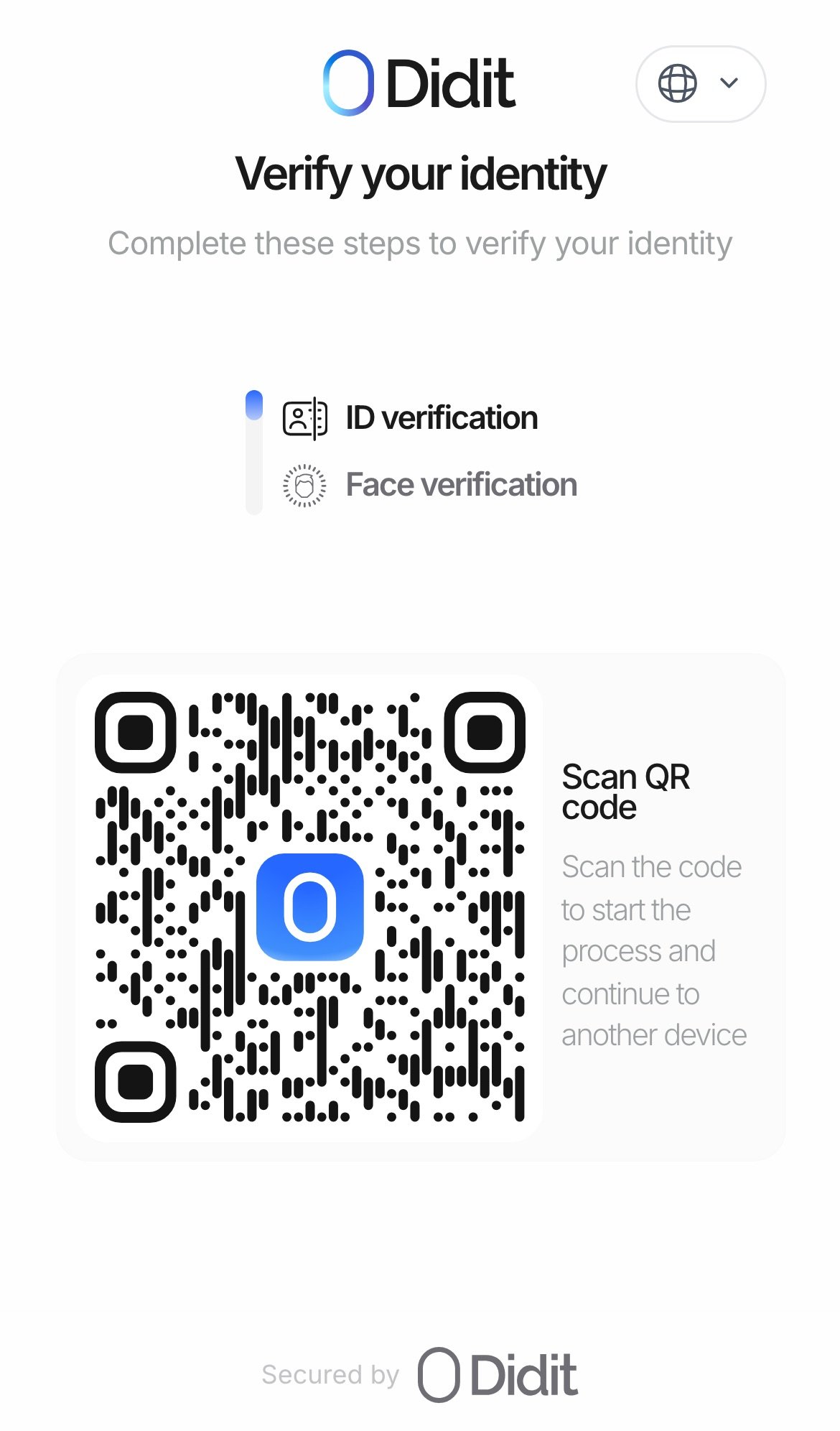
D-->>App: Verification page
Note over App,D: ID document + selfie
D->>API: Webhook: Approved (signed)
API->>D: Fetch the decision
Note over API: identity hash = HMAC(salt, country | type | number)
API->>R: Worker
R->>L: setVerified(wallet, identityHash)
R-->>App: 0.5 MON for fees
```
1. The webhook is checked with an HMAC signature over the raw body and must be less than 5 minutes old.
2. The webhook only says *approved*; the backend fetches the decision from Didit itself for the document.
3. The **identity hash** is an HMAC, keyed with a server secret, over the document's issuing country, type and number, normalised. The key means nobody can brute-force a hash back into a document number.
4. If the hash is already bound to another account, the result is **duplicate**, both in the database and, as a backstop, in the contract.
5. Once `setVerified` is confirmed onchain, the account receives a one-time MON drip for network fees.
 ## What is stored where
| Where | What |
| - | - |
| Monad | `identityHash ↔ wallet`, and `isVerified` |
| Matocard database | The status (`pending`, `approved`, `rejected`, `duplicate`) and the hash |
| Didit | The document images and selfie, under Didit's data policy |
No name, document number or photo is ever written onchain or shown on the public record.
## The source of truth
The app and the API gate top-ups and sends on the **contract's** `isVerified`, not on the database row. Accounts verified onchain by other means count; a database row alone does not.
## Limits of this design
* The bound is **permanent**: no unbinding, no rebinding. A lost passkey today means a lost account; a timelocked recovery that rebinds a verified identity is on the [roadmap](/overview/roadmap).
* Matocard and Didit are trusted to verify honestly. See [Trust model](/learn/trust-model).
This documentation is built and hosted on [Mintlify](https://mintlify.com), a developer documentation platform.
## What is stored where
| Where | What |
| - | - |
| Monad | `identityHash ↔ wallet`, and `isVerified` |
| Matocard database | The status (`pending`, `approved`, `rejected`, `duplicate`) and the hash |
| Didit | The document images and selfie, under Didit's data policy |
No name, document number or photo is ever written onchain or shown on the public record.
## The source of truth
The app and the API gate top-ups and sends on the **contract's** `isVerified`, not on the database row. Accounts verified onchain by other means count; a database row alone does not.
## Limits of this design
* The bound is **permanent**: no unbinding, no rebinding. A lost passkey today means a lost account; a timelocked recovery that rebinds a verified identity is on the [roadmap](/overview/roadmap).
* Matocard and Didit are trusted to verify honestly. See [Trust model](/learn/trust-model).
This documentation is built and hosted on [Mintlify](https://mintlify.com), a developer documentation platform.